
Veloura Stories
← Library
When the Bell Fell Silent
Mythology·Free in full

When the Bell Fell Silent

Chapters · 49 min

About the story

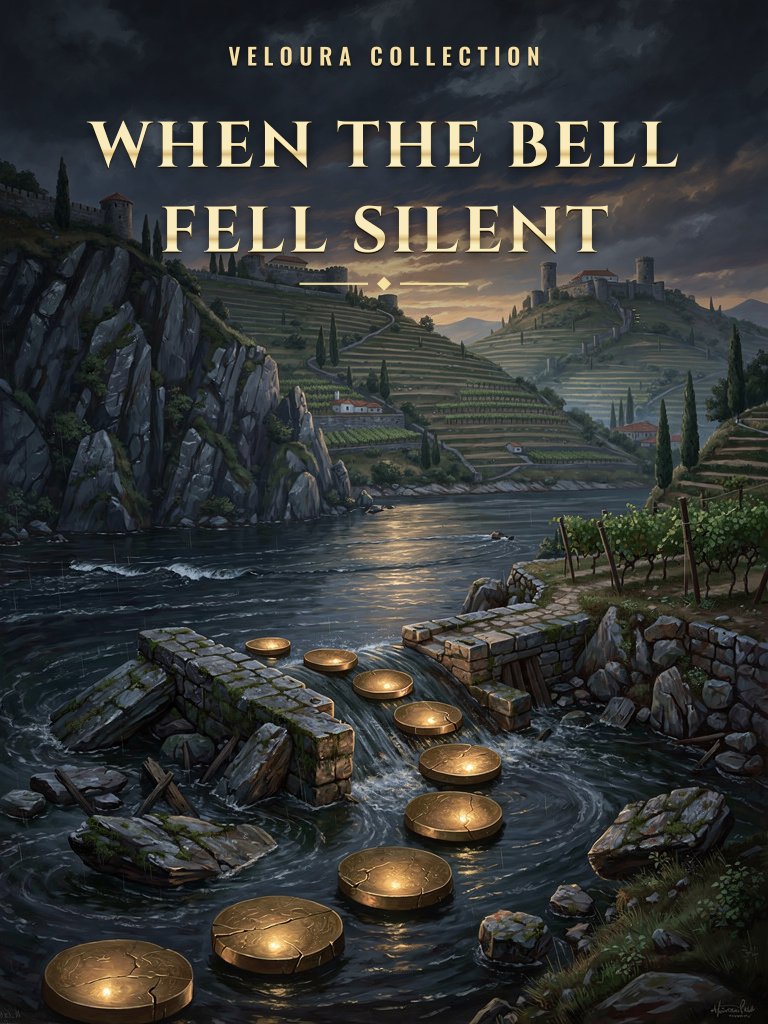
As the flood rises along the Douro, the small bronze bell Camala has just cast cracks on its second stroke. By evening, the river goddess Nabia's driverless cart will arrive at the stop stone on the bank, but the water has cut the riverside road, and Camala cannot lift her father Anselmo, who cannot walk, onto the cart's high step alone. Rising from the water, Nabia asks her to build a way for her father and sends her to Martinho Correia, the road master at the head of the narrow causeway. Martinho knows how to build a crossing, but first Camala must beat him in a race along the narrow road where the water spills over the embankment. Her mind is still on the cracked bell, and with every minute the water creeps closer to her father's cart.

Theme · Sometimes, to save people, you must stop mending what is broken and build a new crossing.

Chapter 1

The Road Beyond the Crack

On the stone terrace above the Douro, Camala shook the small bronze bell she had just cast. The first note rang clear. On the second stroke a thin crack crept up from the bell's lip, and the third note never came. Camala wiped the bell on the hem of her short wool tunic, stained with soot, and pressed her thumb against the crack. She wanted to believe that with a little more work she could mend it.

Below her the swollen water had cut the riverside road. Beyond it, the stop stone, marked with reeds, stood empty for now. Nabia's driverless service cart would arrive there by evening; it found its own way along the riverside road.

“Leave the bell and look at the water,” said her father, Anselmo.

The silver-bearded man sat on his low wooden cart. He tugged the end of his thick cloak out from under the wheel. The water had reached the lowest stone of the terrace. Camala looked at the empty stop and thought of the high step of the cart that would come in the evening, then turned back to her father, who could not walk. Even if she carried him to the stop, she could never lift him onto the cart alone.

“How am I going to get you on board?”

A woman rose out of the water. Reeds were threaded through her dark hair. Her deep blue cloak went on rippling even after she stepped onto the bank, and her bare feet left wet prints behind her. Camala recognised Nabia, the river goddess.

“Anselmo must catch the evening cart,” said Nabia. “Build him a way to board it. Martinho Correia is at the head of the narrow causeway. He knows how to build a crossing, but first you must beat him in a race.”

Camala looked at the cracked bell. She raised it for one more try, then set it down on a dry stone beside her father.

“Can you stay here?”

“I can,” said Anselmo. “But be quick. The water is rising.”

Camala flung her braid back over her shoulder and ran to the head of the stone causeway. A man was waiting there with a measuring cord at his belt, stone dust on his hands, and a long stride.

“Martinho?”

The man measured the narrow causeway with his eyes, then turned to Camala.

“First, look where you put your feet.”

Chapter 2

As Far as the Third Stone

Camala looked at the ground beneath her feet. Even where the causeway seemed dry, a thin film of mud lay over it. Ahead, three carved stones stood at intervals along the edge of the road. Martinho tightened the measuring cord at his belt and pointed to the first stone.

“Whoever reaches the third stone first wins. Ready?”

Camala nodded. Martinho began to run. His strides were long and even, and Camala fell in behind him at once. By the first stone the Douro was spilling over the edge of the causeway. A cold current struck her ankle and she stumbled. She flung out her arms and caught her balance, but Martinho had pulled a few steps ahead.

As she neared the second stone, Camala saw the colour of the road change ahead of her. The wet stretch began there. If she crossed it slowly she would lose; if she stepped carelessly she might fall into the water. She remembered what Martinho had said a moment ago and dropped her eyes to the ground just before her feet. She picked out two hard outcrops of stone; the third lay a little further on.

“I'm coming,” she said, more to herself than to anyone.

She stepped onto the first outcrop. Then, without breaking stride, she leapt to the next. Her foot slipped and her knees buckled; she righted herself before she fell and pushed off from the last outcrop. The water was flowing over the causeway now. Camala quickened, passed Martinho, and laid her hand on the third carved stone before he did. For a while she only gasped for breath. Martinho caught up and stopped beside the stone.

“You won,” he said. “Now look at the bank. What should the way be, from your father's low cart up to the high step of the service cart?”

Camala looked down. The gap between the water and the dry ground was widening.

“My father's cart must be able to go up without being jolted.”

Martinho crouched and unwound his measuring cord. He marked three points on the ground and pressed them down with his palm.

“We'll lay a base of three solid stones. We'll rest the planks across them and brace them from the sides with other planks. If we keep the slope shallow, we can take the cart up to the high step together.”

They picked up the planks lying at the dry end of the causeway. Martinho walked in front, and Camala carried the back ends on her shoulder. As they turned back toward Anselmo's cart, Camala listened to the water. Its sound was closer now.

Chapter 3

When the Stone Sat Firm

They set the planks down beside the marked stone. Camala saw the cracked bell lying next to Anselmo's low cart. The split that had opened on the second stroke was still there; the third note had never come. Her hand strayed to the casting tools at her belt; if she tried one more time, perhaps the sound would come back.

Then the water touched the wheel of the cart. Anselmo drew the hem of his thick cloak up.

“The way must be ready before the service cart comes,” he said.

Camala set the bell on the dry side of the cart. Martinho was already measuring where the first stone should go. Camala knelt where he pointed, smoothed the earth with her palm, and pressed the base stone into place with both hands. As she set the second, the roar of the current drowned out their talk. She wedged gravel around the third stone. Then together they laid a plank across the stones.

The middle stone shifted. When the plank knocked down, Camala's shoulder tensed; she wanted to throw her weight against it, as she had in the race. Martinho held the end of the plank, but he did not press down on the stone.

“Left like this, the cart will slip as it crosses,” he said.

Camala lifted the plank back off. She cleared the wet earth from beneath the stone and packed larger pebbles around it. This time she pressed down on each corner of the stone, one by one. It did not budge.

“Now let's try it.”

They laid the planks and propped the braces against their sides. Camala walked two paces, as if driving an empty cart up the ramp; the planks stayed where they were. When the driverless service cart halted at the marked stone, they rested the end of the ramp against its high step.

Martinho went behind Anselmo's cart. Camala pulled from the front. When the wheels climbed onto the first plank, Anselmo gripped the side of the cart with both hands. As they passed over the middle brace, Camala slowed. The stone did not move. With one last push they brought Anselmo's cart onto the service cart. Camala stepped in too and stood beside her father. As the water covered the bank, the two of them were on the driverless service cart.

Chapter 4

After the Silent Bell

The driverless service cart did not leave the bank at once. Camala looked at her father; Anselmo was gripping the side of his low cart, his eyes fixed on the neighbours waiting by the ramp. To help them, Camala climbed down from the service cart again and went out onto the planks. The water had begun to swirl around the first base stone.

“Come one at a time. Don't stand in the middle,” she said.

She took the hand of the neighbour at the front, then showed the others where to step. Martinho stayed behind; as each of them crossed the middle brace, he set his foot beside the stone to feel whether it shifted. When the last neighbour had boarded the service cart, Martinho pulled up one plank of the ramp and passed it inside, then climbed in himself. Camala went back to her father.

Nabia stood on the bank, her bare feet touching the water. She laid her hand on the current, and for a moment the water seemed to still. The driverless cart rose slowly from the flooded bank toward the upper terrace. Camala held the wheel of her father's cart steady with one hand. Her other hand rested on the side of the service cart, as if it were still feeling for the stone of the ramp.

On the upper terrace the ground was dry. When Camala and Martinho lifted Anselmo's low cart down from the service cart, Anselmo turned the wheels himself. The wheels stopped on firm ground; this time the cart did not rock.

“We made it,” said Anselmo.

Then he looked at the families behind them.

“All of us.”

Camala showed the families the plank Martinho had brought aboard. Merely laying it on the ground would not be enough. She knelt and set two stones facing each other, testing both with her hands before she let go.

“Pack the base first. Then lay the plank across and brace it from the sides. Before anyone crosses, test it with a load,” she said.

The neighbours repeated what she had done. Martinho left his measuring cord at his belt; this time everyone set their own stones in place. Camala did not hurry them; she waited.

Far below, the cracked bell that Camala had left on the dry side of Anselmo's low cart had stayed where it was when they took the cart up the ramp. The water had covered that spot, and the bell was no longer visible. No one had heard its voice. Camala looked at the families working over the stones and the plank. She was no longer the only one who knew how to build a crossing.