
Veloura Stories
← Library
Wind over Hormuz
Emotional·Free in full

Wind over Hormuz

Chapters · 47 min

About the story

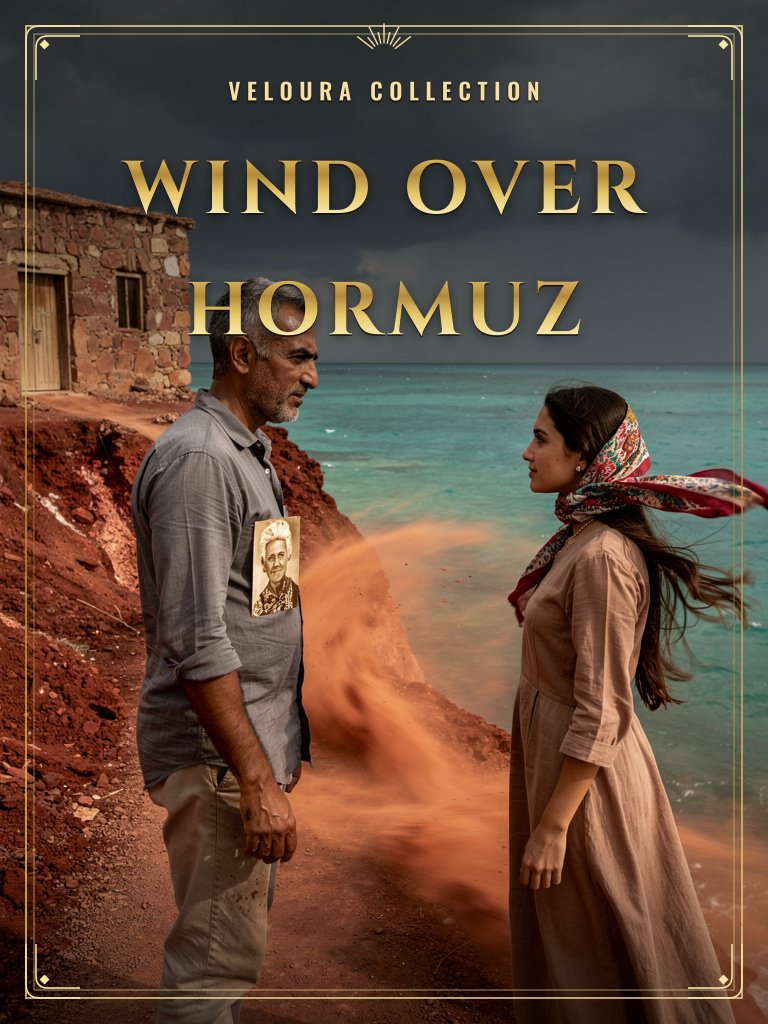
Bahram Rostami is a man who retired after thirty years on the police force and chose to live without speaking to anyone. His aunt Shahnaz's will has tied him to the red-clay house on Hormuz Island, on a single condition: he must not dismiss the house's young maid, Soraya Nikbakht. Bahram treats the condition as a burden. He builds a thick wall between himself and Soraya, says nothing to her, and avoids her eyes. But as the season's first great storm rises out of the Persian Gulf, the ferries are cancelled and the island is cut off from the world. Two strangers are left alone under one roof, without electricity. As the storm worsens, the old secrets of the house begin to surface, and it becomes clear that Soraya was far more to Shahnaz than a maid. In his aunt's letters, Bahram discovers her true intention: the will was a patient trap, set to keep two people together. While the roof leaks and the candles gutter, the coldness between them slowly warms. When the storm reaches its peak and water begins to seep into the house, the two come face to face with the aunt's last letter, a single sentence that commands no love and offers only a chance. When the wind dies down, the ferries run again, but Bahram no longer wants to leave the island. On the red sands of Hormuz, the two are together now not because of the will's condition but because of their own choice.

Theme · Real closeness is the work not of circumstance, but of chosen patience and honesty.

Chapter 1

The Silence Before the Storm

The earth of Hormuz always looked redder in the mornings, before the sun had fully risen. Bahram Rostami pulled the door of the red-clay house, left to him by his aunt Shahnaz, shut behind him, gripping the small cloth bag in his hand. The bag was Soraya's. He had not asked what she had put inside; he had not wanted to ask.

The condition of the will was plain: the house would be his, but only as long as Soraya worked in it. Bahram had never liked that condition. It was strange to feel that a dead woman's hand still steered him. Still, he had made up his mind. Before the storm came he would send the girl to the mainland, and then he would return, alone and in silence, to the emptiness of the house.

When they turned onto the road to the harbour, the sea was wilder than usual, the waves slapping against the planks of the jetty, the smell of salt mixed with the wind. Soraya walked a step behind, the colourful scarf on her head tied tight, saying nothing. Bahram said nothing either. He had long since decided there was no point in talking to her.

On the jetty they found Kaveh Ahmadi, his thick moustache trembling in the wind, his hands wrestling with the boat's ropes.

“Today is the last crossing,” Kaveh said, squinting at the horizon. “Maybe not just the last. Maybe there won't be one for a long while.”

Bahram frowned.

“What do you mean, a long while?”

“A big storm is coming, Mr. Bahram. The harbour authority just sent word. After today, no boat will go out. A week, maybe more.”

Bahram looked at the bag in his hand, then at Soraya. On the girl's face there was neither fear nor relief, only a silence, a kind of waiting.

The wind suddenly gathered strength and lifted the sand into the air. Kaveh jumped into his boat and threw them one last look.

“May God help you,” he said, and cast off the rope.

Bahram realised that the cloth bag in his hand would not be going anywhere now.

Chapter 2

Confessions by Lamplight

By evening the wind was no longer a howl but a fist, shaking the stones of the house. The electricity went out just as Bahram was brewing his tea; the flame on the stove died at once, and the house sank into darkness.

“I need to close the windows,” said Soraya, her voice unhurried but firm. “The wind is hitting this side. They'll break.”

They walked to the windows together. Bahram held the wooden shutters while Soraya hammered in the nails, her hands quick and practised, as if she had known this house through dozens of storms. Then she lit the gas lamp, and the yellow light warmed the room and seemed to push the roar outside a little further away.

“Shahnaz Khanom always sang during storms,” Soraya said suddenly, adjusting the lamp's wick. “So that I wouldn't be afraid. When my family drowned, she was the one who took me in. I was thirteen. Nobody wanted me. She did.”

Bahram said nothing. The words stuck in his throat; hearing his aunt's name spoken so closely, in so warm a voice, he did not know how to answer.

Toward midnight he found a dusty box at the very back of a cupboard: letters, all in Shahnaz's handwriting. He opened one and held it up to the light. Today Soraya picked the figs in the garden; her laughter does these walls good. In another: I love her like my own daughter. I have told no one, but I thought I should write it down at last.

His hands trembled slightly. There was a side of his aunt in these letters that she had never shown him, and inside that side, strangely, was the woman sitting across from him.

“What are you reading?” Soraya asked, turning her face to him curiously in the lamplight.

Bahram held the letter in his hand, opened his mouth to answer, then closed it.

Chapter 3

Confession in the Rain

He could not answer, because at that very moment there came a crack from the corner of the ceiling, and then water. These were not the first drops; it was a waterfall. A number of the tiles had surrendered to the wind, and the timber frame of the ceiling gaped open.

“The boxes!” Soraya shouted, already running.

Shahnaz's letters and old photographs sat in the chest in the corner, and the water was now moving toward it. Bahram set the lamp down and threw open the lid, and together they filled their arms with armfuls of paper. All the while they pushed aside a plank hanging from the ceiling and crossed into the next room, through soaked skirts and sweating brows.

At the bottom of the last bundle lay a yellow envelope, with only two names written on it: Bahram, Soraya.

The letter was short.

> “I did not want the house to be yours, my children. I only wanted you to gain enough time to come to know each other. To truly see a person takes patience, and I could not give you that patience myself, so I let circumstances give it.”

Bahram's hands shook. For a while he stared at the paper, then at Soraya.

“She tricked us,” he said, his voice hoarse. “This whole will, the house, the condition... it was all a game.”

He stood, walked to the door, ready, it seemed, for the storm outside, for getting soaked, for anything. Soraya stepped in front of the door and laid her hand on his arm.

“Where are you going? In this wind?”

“I don't know.”

They fell silent. The lamplight trembled between them; outside the wind still pounded the stones of the house, but inside, all at once, everything seemed to have stopped. Bahram looked at her, and beneath the anger something else rose, and before he even knew it himself he leaned in, his lips touching hers, slowly, as if asking a question.

Chapter 4

The Quiet After Dawn

In the morning the sky was so clear that Bahram had to squint. The storm's traces were everywhere, broken tiles, scattered branches, sand heaped along the edges of the lanes, but the sea lay calm, blue as if nothing had happened.

When Kaveh's boat appeared on the horizon, the two of them were standing on the red beach, a metre of empty space between them, though at midnight that space had not existed. Bahram put his hand in his pocket, took it out, then put it back. He did not know how to say what he wanted to say; words had always come out of him like a report, flat and cold. But this time he did not want it to be that way.

“It isn't because of the condition in the will,” he said at last, his voice a little rough.

Soraya turned to him, her hair still tousled by the wind.

“Then what is it because of?”

“I want you to stay because... because last night, closing the windows, with the roof leaking, nothing mattered anymore except being beside you.”

There was a silence, but not the frightening kind. Soraya smiled, a light in her eyes warmer than the sun's reflection off the water.

“If Shahnaz Khanom knew,” she said, “she would be so pleased.”

“Maybe she did know,” said Bahram. “Maybe this is what she wanted all along.”

The boat's engine could be heard more clearly now. Kaveh was waving, his voice lost in the wind, but his grin was visible even from far away. Bahram touched Soraya's hand, their palms pressed together, warm and sure.

The house stood behind them, its red-clay walls gleaming in the sun, its roof waiting to be mended, but it was no longer a burden. It was a beginning. The sea stretched out before them, calm and endless, and neither of them wanted to go anywhere.