
Veloura Stories
← Library
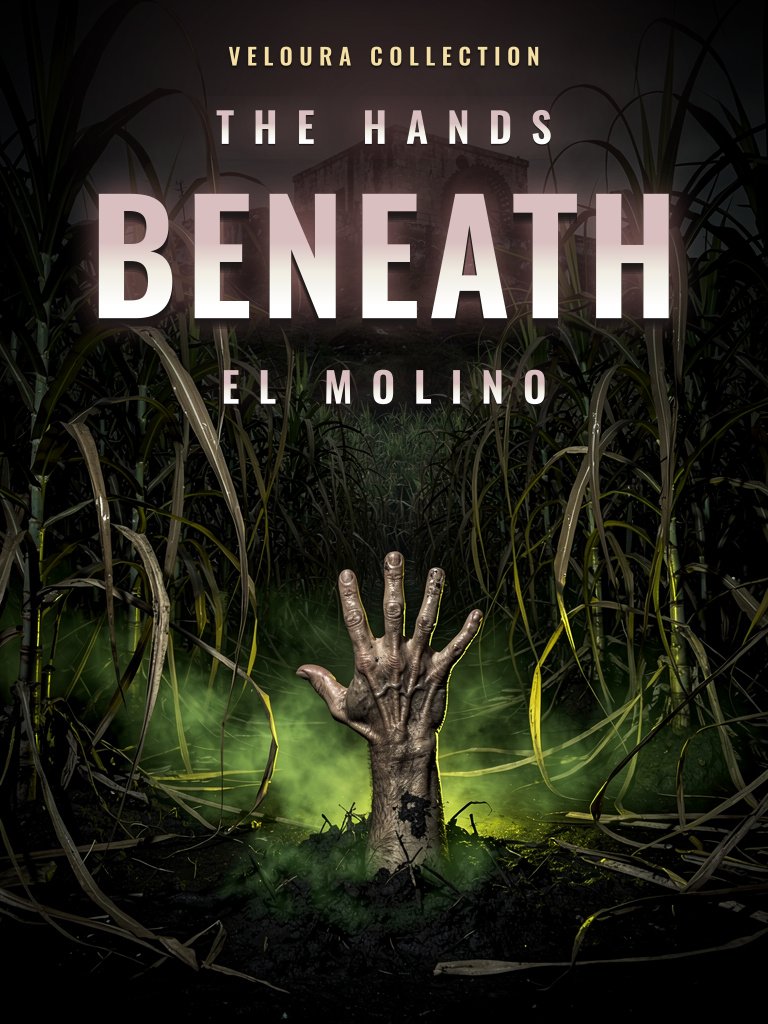
The Hands Beneath El Molino
Horror - Thriller·Free in full

The Hands Beneath El Molino

Chapters · 49 min

About the story

In Paso Oscuro, a town among the sugarcane fields of Veracruz, Marisol wakes at four in the morning with a strange feeling inside her and goes to her daughter Valentina's room. The wall is covered in small handprints of red clay. Valentina's voice, her tone, everything about her is right, but when she hugs her mother, her hands no longer squeeze. The neighbours have found the same marks on their walls, yet no one is worried; their eyes are strangely empty and calm. Marisol goes to Don Cástulo, who lives on the edge of town, and hears what lies beneath the old El Molino mill. The old man gives her a shard of broken mirror and one warning: she must not look at anything down there directly. Marisol breaks the mill's rusted lock and begins to descend the dark stairs.

Theme · A mother’s love can know her child even in the deepest dark — but the dark knows it too.

Chapter 1

Wet Prints, Dry Walls

It was barely four o'clock. When Marisol opened her eyes there was nothing in the room, only that feeling. The one a mother knows. Something was wrong.

She got up, her bare feet on the cold floor. She stepped out into the hallway. Valentina's door was shut, but no light seeped from beneath it. She went on anyway.

Before opening the door she stopped for a moment. No sound came from inside, not even breathing. Then she opened it.

Valentina was sitting up in bed, rigid, her hands on her knees, her eyes fixed on the wall. Marisol followed her gaze.

The wall was full.

Small handprints, the size of a child's hand, perhaps smaller, lined the plaster. They weren't random; on the contrary, they were evenly spaced and spread across the whole surface, as though someone had labored over them for hours. Marisol brought her finger close. Red clay. Still faintly damp.

When?

Just then Valentina turned.

“Good morning, Mom,” said the girl. Her voice was right. Exactly right. The intonation, the emphasis, everything was Valentina.

Marisol drew a breath and moved forward. She knelt beside her daughter and gathered her up. Valentina hugged her back, wrapping her arms around her mother's waist, resting her head on her shoulder.

But her hands did not squeeze.

Marisol had been waiting for it without knowing: those small fingers clinging to her back, that brief clutch. Valentina did it every morning. Every morning, without exception.

This morning the hands simply rested there. They had weight, but no intention.

Something inside Marisol pulled taut, then snapped.

---

By morning, whispers had begun to pass through the narrow streets of Paso Oscuro. Her neighbor Remedios had seen the marks on her wall. Old Fortino's house was the same. No one was worried, and that frightened her most of all.

“The kids must have been playing,” said Remedios, shrugging. Her eyes looked at Marisol but settled on nothing. Empty, calm, faintly smiling eyes.

Just like her daughter's.

Marisol looked around. There were three more fathers in the street. They were all speaking with the same expression: relaxed, untroubled, a little too calm.

The children beside them were watching them.

Waiting.

Chapter 2

Broken Mirror, Old Counsel

Avoiding the children's stares, Marisol slipped out into the street. She quickened her steps, but not too much; if she ran, she would be admitting that something was after her.

She found Don Cástulo at the edge of town, in a plastic chair in front of his own house. His hat lay on his knee, and his hands slowly turned its brim. She looked at his wall. The outsides of the other houses had been marked with clay, worked in down to the spaces between the fingers, now dried. Don Cástulo's wall was white and spotless.

“Sit,” said the old man, before Marisol had said anything.

She sat. For a while neither of them spoke. The hot, heavy wind from the sugarcane fields passed between them.

“You know El Molino,” said Don Cástulo. He was not asking.

“The old mill at the edge of the field?”

The man tilted his head slightly. He wasn't looking at Marisol but at the ground, at the earth right in front of him.

“Those who built it built it there because they knew what was beneath. It was already there. The mill only covered it over.” He paused. The hat kept turning in his hands. “They processed sugarcane. They processed other things too.”

“What do you mean?” said Marisol, her voice dropping.

“Children who went in would come out,” said the old man. “But what came out was... not whole. The faces were right. The voices were right. But it was something else now.” He waited a moment. “Down there, they use them like molds. The way a potter gathers molds.”

Something knotted in Marisol's stomach. She thought of Valentina sitting rigid in her bed, of the hands that didn't squeeze.

“Valentina—”

“I don't know,” said Don Cástulo, at once. He had said it too quickly. “I can't tell you that.”

Marisol stood. Her legs did not feel solid.

The old man put a hand in his pocket and took out something small. A shard of broken mirror, small enough to fit in a palm, its edges jagged as though it had broken without a blow.

“If you go down there,” he said, without looking into Marisol's eyes, “don't look at it directly. Look with this.”

She took the mirror. The glass was cold, strangely cold in this heat.

“Why?” she asked.

Don Cástulo set his hat back on his head. The conversation was over.

As Marisol left his house, one thing stayed in her mind: the old man had not said if. He had said when you go down.

Chapter 3

The Hands Below, the Hanging Children

The iron lock on El Molino had rusted, but in Marisol's hand there was a resolve like stone. The iron bar she had found struck the lock three times; on the fourth it fell to the ground, its sound swallowed by the damp earth. When the door opened, the smell that came from inside stopped her for a moment. Wet sugar. Rot. And beneath those, something much older, something she couldn't name.

The staircase was long. Stone, cold, slick. At every step Marisol touched the wall with her hand, but when she felt the surface of the wall she pulled her hand away. Under her fingertips there were raised shapes, small, round, endless.

Handprints. Up to the height of the ceiling, layer upon layer, pressed one over another. Some were fresh; some were so old they had become one with the stone itself.

When she reached the bottom, the chamber opened out.

It was vast. No one could have guessed there was so much room beneath the mill. Nets woven of dried cane fibers hung from the ceiling, and in every net a child hung. Motionless. Eyes open but looking at nothing. They were breathing, their chests rising and falling slowly, but they weren't there.

Marisol's eyes swept the room. Red ribbons.

Valentina hung in the middle. Her white dress was covered in red clay stains, her two braids swaying on her shoulders. Her eyes were open but empty, a true emptiness, different from the one Marisol had seen in her room that morning.

That is my daughter.

She took a step. Then she stopped.

It came out of the shadows.

It had the shape of a child but was not a child. Its skin was pale, covered in dozens of small handprints, just like the walls, but these were worked into its flesh. Where eyes should have been there was only flat, smooth skin. It did not move. It only waited.

Marisol reached into her pocket. The shard of mirror settled into her palm; its edge cut her skin, but she didn't even notice the pain. Don Cástulo's words flashed through her head: Don't look directly.

She raised the mirror and adjusted its angle. She looked not at La Cosa but at its reflection.

What she saw in the reflection was not a child. It was a hollowed-out, empty thing, the shape that nothingness had taken.

The presence drew back. A small movement, almost imperceptible, but real.

Marisol ran. The cane fibers around Valentina cut her hands, but she pulled, tore, ripped them away. When her daughter fell into her arms the chamber shook; the old handprints crumbling from the walls turned to dust, and the stone groaned.

Chapter 4

Morning Among the Cane

The stairs were dark, and the groaning of the ceiling came closer with every step.

Marisol held Valentina tight in both arms, climbing the steps almost blind. The girl's weight sank into her arms, a real weight, warm and heavy, but Valentina did not stir. Don't let her stir, just let her breathe, just let her breathe. Behind her the walls thundered; that deep sound rose, of old stones crashing together, of earth caving in on itself.

She struck the cellar door with her shoulder. It opened.

The outside, cane, a dim sky, the smell of damp earth, hit her in the face. Marisol staggered forward a few steps, then fell to her knees. At that very moment the underground chamber collapsed: the stones folded inward like a long, tired breath. Dust and earth rose in a cloud around her feet.

Silence.

Valentina lay motionless in her arms.

Marisol looked at her daughter's face. The eyes were closed, the lips parted. Breathe. Please. One second passed. Two seconds.

Then Valentina's chest trembled.

Small hands grasped Marisol's neck, weak, disordered, with the grip of a real child. She buried her face in her mother's neck and began to cry. An ugly, snotty, hiccuping sob, a sound like nothing else, belonging only to her.

Marisol cried too. Without a sound, only her shoulders shaking.

Morning came.

The handprints on the walls of Paso Oscuro slowly faded; first their color lightened, then they were wiped away, as though they had never been. The parents who had wandered the town with empty eyes came back to themselves one by one; they looked around with the childlike expression of people who are dazed, exhausted, not quite knowing what had happened.

When Marisol got home she did not go inside. She sat down on the concrete step by the door and laid Valentina across her lap. The girl was asleep, truly this time, her breaths uneven, her hair plastered to her face.

The sun rose over the cane fields. Pale at first, then orange, then scorching.

Marisol did not squint. She only looked.

She wasn't ready to go inside yet. But her daughter was in her arms and the sun was rising, and that, for now, was enough.