
Veloura Stories
← Library
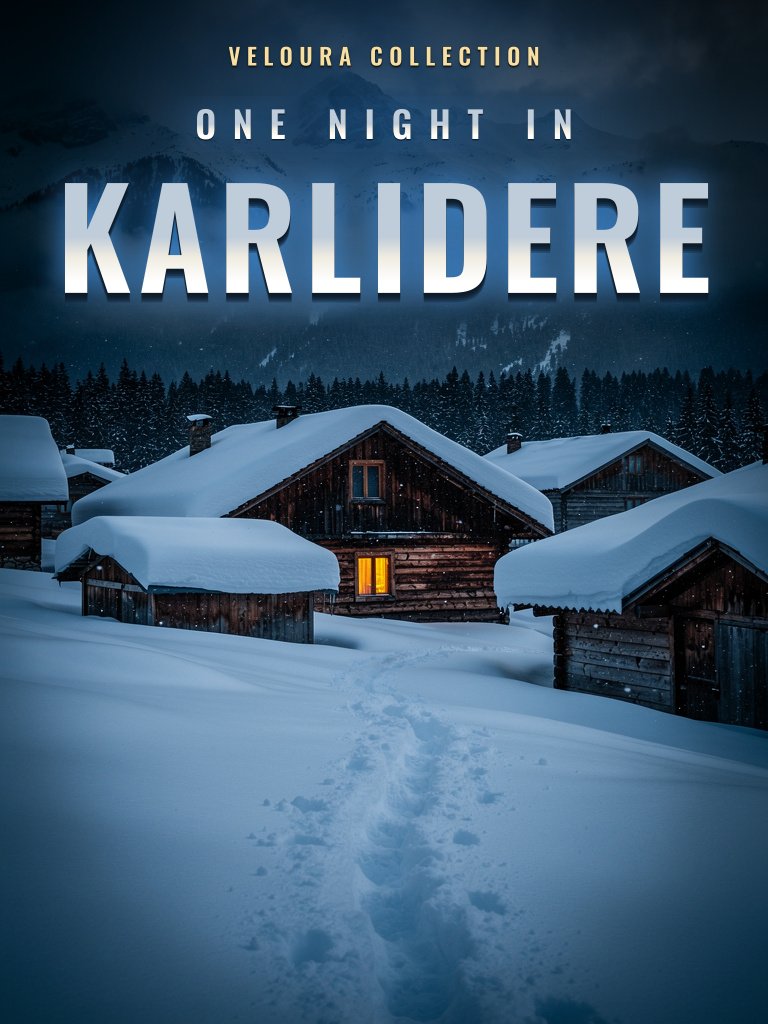
One Night in Karlıdere
Thriller·Free in full

One Night in Karlıdere

Chapters · 48 min

About the story

Karlıdere is a tiny village in the mountains of the Eastern Black Sea, cut off from the world each winter. Elif is its only nurse, and a mother trying to stay on the right side of both the state and her own conscience. Years ago, the smuggler Cemal saved the life of her son Ege, and she gave him a promise she had long since put out of her mind. But on a stormy night, when Cemal staggers up to the clinic door drenched in blood, that promise comes back and will not let go of her. The same night, a wounded gendarmerie sergeant who has been tracking Cemal knocks at the door too. The roads are closed, no help is coming, and there is no way out. Elif finds herself forced to hide two men who hate each other under one roof. As the night wears on, she realises this is no ordinary hunt for a smuggler: there is a buried scandal, a pact of silence, and a witness who must die. All Elif has is her medical knowledge, her common sense and a mother's instinct to protect her child. Before dawn, she must repay her debt, let no one die, and bring her son through the night alive. The silence of Karlıdere, it turns out, was only the herald of the greatest danger.

Theme · Repaying a debt of humanity can weigh heavier than standing on the right side of the law.

Chapter 1

Blood at the Door

The wind hammered the windowpanes so hard that sometimes even the flame in the stove flinched and shrank. Elif tucked Ege's blanket a little tighter around his shoulders, then put down the roll of bandage in her hand and looked out of the window. Outside there was a white wall, and nothing else to be seen. The roads of Karlıdere had been closed for three days; in a storm like this, she had thought, not even the gendarmerie post could send anyone out. She was wrong.

The door was knocked on, softly at first, then with its whole weight. Elif leapt to her feet, her heart pounding in her chest like a fist. Ege raised his head from beside the stove, his eyes fixing on the door with that same watchful look of his.

“Mum, who is it?”

Elif did not answer. When she opened the door, the first thing she saw was the blood: a dark, spreading stain on the snow. Then she saw the man. He was slumped against the wall, one hand clamped over his shoulder, blood seeping between his fingers. His face was familiar, but it was a familiarity she had no wish to acknowledge.

“Nurse Elif...” the man said, his voice hoarse, his teeth chattering. “Help me.”

Elif took a step back. The pleading in the man's eyes collided with a voice inside her own head: you know this man, and this man knows you. Cemal's face was twisted with pain, but his eyes still held that old, unbending pride.

“I pulled Ege out of the river,” he said, his breath coming in ragged bursts. “The bleeding wouldn't stop, and we couldn't wait for the doctor. Now it's my turn. Let me in, Elif. Just one night.”

Elif's hands were shaking. Behind her she could hear Ege's breathing, the crackle of the stove, the sound of her own heart. She knew what it meant to let this man in: he was someone the gendarmerie was after, perhaps a smuggler, perhaps worse. But she also knew that her son was still breathing because of this man's hands.

Outside, far off beyond the curtain of snow, two dim lights appeared. They were coming closer.

Elif took Cemal by the arm, pulled him inside and shut the door fast behind him.

Chapter 2

The Man Who Knocked

The door was pounded on, then kicked. Elif went cold all through. She shoved Cemal into the back room, the storeroom where the medicine cabinets stood, and put a finger to her lips.

“Don't make a sound,” she said, her eyes locked on his. “And take Ege with you, over by the stove, under the blanket.”

When she opened the door, a man stood there with a bloodied shoulder and a torn uniform. His breath came out in clouds, and he could barely stay on his feet.

“Gendarmerie,” the man said, his hands shaking as he tried to show his ID. “I was chasing a smuggler. He shot me. I need help.”

Elif let him in and laid him on the gurney. His eyes swept the room, every corner, every door, as if counting them. That is not the look of a man asking for help, Elif thought, but she said nothing.

She took the suture needle and was cleaning the wound when, from behind the wall, from the storeroom door, came a faint whisper.

“Don't believe him,” said Cemal's voice, thin as a breath. “That bullet isn't mine. He was shot by one of his own men.”

Elif's hand stopped. The needle hung in the air above the skin. Then she carried on, trying to look calm.

“Where did you say you were shot?” she asked, her voice flat.

“Down on the road,” the man said, closing his eyes. “The road into Karlıdere.”

But the wound was at the back of the shoulder, not the front. Someone had shot him from behind. Elif noticed this and said nothing; she only pulled the thread tighter.

Outside, the snow was still falling, silent and stubborn. Elif glanced out of the window: the road could no longer be seen, as if it had been wiped out by the snow. The news she had heard on the radio that morning, about the road closures, rang in her ears now: not a single vehicle would get through before morning.

Four people, one house, one whole night.

The man's eyes half opened and followed her. His voice was softer this time.

“There's no one else here, is there?” he asked. “Just you and your son?”

Elif finished the stitching, but her hands were still trembling.

Chapter 3

When the Bottles Fell

“Yes,” said Elif. Her voice sounded too flat, even to her own ears. “Just me and my son.”

At that very moment came a rattle from the storeroom, then the clink of glass bottles knocking together. Ege's foot had caught on the boxes of medicine on the shelf, and two bottles had toppled to the floor. Elif's heart dropped in her chest like a stone.

The sergeant turned his head. First surprise flickered in his eyes, then calculation.

“What's in the storeroom?” he asked, rising from the gurney. The wound must have been pulling at him, but there was no pain on his face, only attention.

“Supplies,” Elif said quickly. “Things I keep for the winter.”

The sergeant did not listen. Bracing his good arm against the wall, he walked to the storeroom door and kicked it open. Inside, wedged between the flour sacks, stood Cemal in his bloodied coat. His hands were empty, but in his eyes was the calm of a man who had surrendered.

The sergeant drew his gun and levelled the barrel at Cemal's forehead.

“Surprise,” he said. There was no courtesy left in his voice.

“You're looking for your ledger,” Cemal said slowly. “But you won't find it. Because it isn't on me. It's somewhere out in the snow, a place only I know.”

The sergeant's jaw tightened.

“What ledger?” Elif asked, her voice trembling.

“For years he's been squeezing money out of the men who cross the border,” said Cemal, not taking his eyes off the sergeant. “Names, dates, amounts, all of it is in that ledger. He didn't come to catch me. He came to silence me.”

“Shut your mouth,” said the sergeant, but his voice was no longer sure.

Elif's eyes slid to Ege, standing in the doorway. The boy didn't move; his eyes were wide open, his face bone-white in the glow of the stove.

“Have your son come here,” the sergeant said suddenly, slowly turning the gun toward Ege. “You tell me where the ledger is, or else—”

Elif did not think. The syringe was still on the table, filled with the sedative left over from the stitching. She took a step and drove the needle into the sergeant's good arm, pressing down with all her strength.

The man spun round, disbelief in his eyes, and then his knees gave way.

Chapter 4

As the Snow Melted

When the sergeant crumpled to the floor, the house suddenly fell silent. Elif noticed her hands shaking as she let go of the syringe, but she did not stop; she checked the man's pulse, then tied him to a chair with rope, tightly.

When Cemal came out of the storeroom his face was ashen, but he was on his feet. In his hand he held an old, brown-covered ledger.

“I said it was in the snow, but I lied. This is his account book,” he said. “How many trucks he got through, who he paid, he wrote it all with his own hand. I carried it on me in case I ever needed it.”

Elif took the ledger and turned its pages. Names, dates, figures: lines in which a man had dug his own grave.

By morning the snow had stopped. When she looked out of the window, the colour of the world had changed; everything was still white, but now motionless, the wind silent too. Elif picked up the radio, not to call the post but to call the district headquarters directly. Her voice did not shake.

“I have a wounded gendarmerie sergeant here,” she said. “And I have evidence.”

By the time the reinforcements arrived, the sun was directly overhead, the snow had turned to water and the roads were open. As Elif handed over the sergeant and the ledger, she felt a strange lightness inside, as though she had set down something she had been carrying on her back for months.

Cemal had gone before the soldiers' voices reached the village. Elif saw him one last time from behind, his back slightly bent, his steps heavy but resolute, until he vanished beyond the hill; he never turned, never even slowed his pace.

“Where is he going?” Ege asked, clinging tightly to his mother's hand.

“I don't know,” said Elif, and she truly didn't. “But he's safe now.”

She held her son closer, and the two of them stood wrapped in the blanket in front of the stove. Outside the snow had begun to melt, drops falling from the roof, slow and steady, like the ticking of a clock.

The debt had been paid, though who had owed whom no longer mattered. Elif knew this much: some debts, even when paying them is dangerous, are worth paying.