
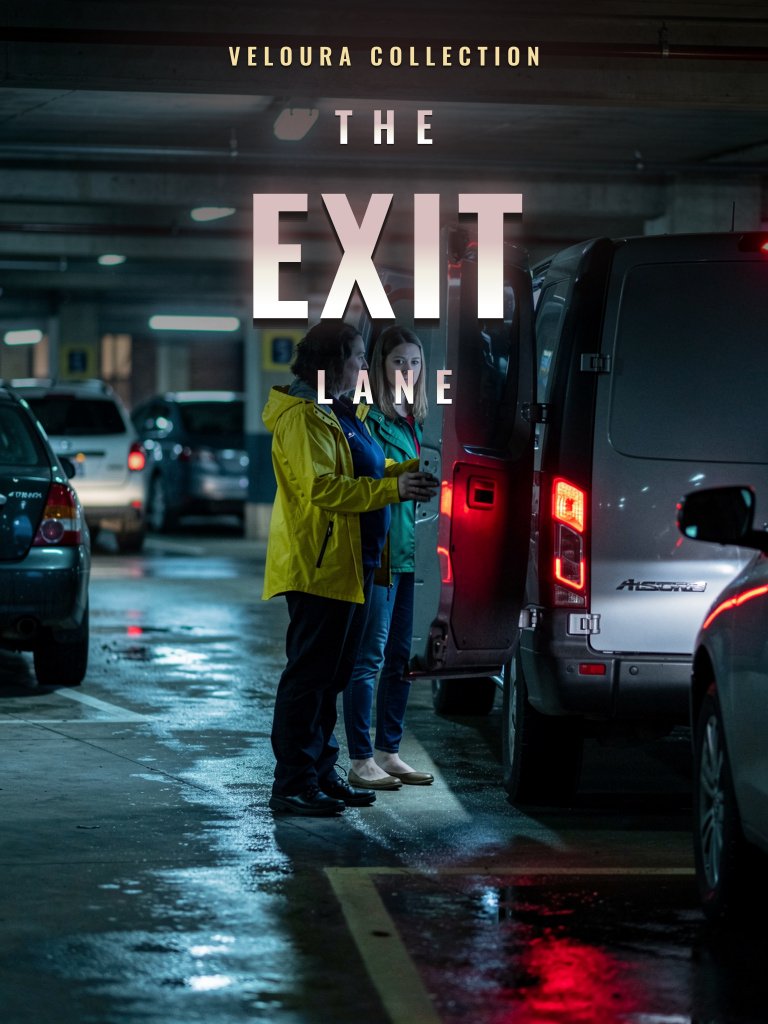
Veloura Stories
← Library
The Exit Lane
Thriller·Free in full

The Exit Lane

A Milwaukee parking attendant sees a woman being abducted. The van may reach the exit before help arrives.

Chapters · 49 minFully narrated

About the story

While checking a payment machine on the top floor of a five-level Milwaukee parking garage, exit attendant Celia Broderick sees a man force a young woman into the cargo compartment of a van. She reports the license plate to an emergency dispatcher; help is about ten minutes away. The van can descend the garage's only vehicle ramp to the exit in a few minutes. Celia can reach her booth by a separate pedestrian staircase. By checking tickets manually during the evening rush, she can create a short queue in the single exit lane, but reaching the woman will take more than that. She remembers seeing an exterior latch at the back of the van and calculates how much time she has left.

Theme · A short queue in the single exit lane buys time for a young woman locked in a cargo compartment to escape.

Chapter 1

The Latch on the Fifth Floor

Listen

It was 5:40 p.m. in the Milwaukee parking garage. Exit attendant Celia Broderick had cleared a paper jam from the fifth-floor payment machine and was about to return to her booth. The sound of tires echoed over wet concrete. In the opposite row, a man in a gray jacket dragged a young woman in a green work jacket toward the back of a van. The woman clung to the door handle; the man pried her hand loose and pushed her into the cargo compartment.

Celia was too far away to intervene. As the rear door shut, she saw the man's hand fasten the simple latch on the outside. He ran to the driver's seat. Celia recorded the letters and numbers of the license plate on her phone and noted the van's color. She also wrote down the woman's green jacket and the man's gray one. The cargo compartment had no windows; she did not know whether the woman could see outside from within. She heard the woman call out from inside, but the words were lost in the engine noise.

She called emergency dispatch.

“I'm on the top floor of a five-level parking garage. A man forced a young woman into the cargo compartment of a van,” she said. She gave the plate, the color, and the garage address.

The dispatcher asked her to stay on the line. Nearby units would take about ten minutes to arrive. Celia looked at the ramp. There was only one vehicle route from the fifth floor to the ground-level exit; without congestion, the descent took three minutes. The van had already entered it.

“I saw a latch on the back that opens from the outside. I have an attendant's booth at the exit,” Celia said.

The dispatcher told her to stay somewhere safe and report what she observed. Celia thought about the single vehicle exit: during the evening rush the ticket reader was operating and drivers passed through one by one. She could reach her booth in about a minute by the separate pedestrian stairs. She could not catch up by following the vehicle ramp.

The van's red taillights curved down to the next level and vanished. Celia zipped up her yellow rain jacket. She listened to the sounds from the ramp. Keeping the phone to her ear, she opened the door to the pedestrian stairs; below, cars were flowing toward the exit lane.

Chapter 2

Tickets Checked by Hand

Listen

Celia took the stairs two at a time. It was a little after 5:41 when she reached the street-level door. The pedestrian route was separate from the exit lane; its door stood beside the attendant's booth. Celia checked the lane first. The van was not in sight. Two cars had approached the automatic ticket reader.

She entered the booth and switched the reader to manual ticket checking. A message on the screen said control had been transferred to the attendant. It was the normal setting used when the machine malfunctioned; she would stop cars and check tickets one by one. The first driver lowered the window. Celia took the ticket, read the date, and completed the payment. The exit barrier rose. Before the driver passed through, the second car had stopped behind it.

She spoke quietly to the emergency dispatcher.

“I'm at the only exit, at street level. I'm taking tickets manually; there are two cars here. The van hasn't appeared yet.”

The dispatcher said the information had been relayed to the units. Celia checked the passage in front of the pedestrian gate. The route was clear; no one was blocking the stair door leading to the sidewalk. The staff key for the pedestrian gate was in her pocket. If she could get the woman out, they would take this route from beside the lane.

The first car passed through the gate. Celia took the second driver's ticket and processed it at the machine; this time she had to count out change. As the driver waited, another car pulled up behind. While counting the coins, Celia thought the driver behind would honk. No one did; brake lights drew closer together. In the mirror Celia saw the bottom of the ramp. The gray van came around the turn and slowed behind the car.

There were two cars between them. Any more might attract suspicion; any fewer and the van would reach the barrier too soon. Celia put the coins in the driver's palm and raised the exit barrier. The van moved forward one car length.

“The vehicle is here. At the back of the line,” she said into the phone.

The dispatcher repeated the plate. Celia confirmed it. Headlights passing in the opposite lane shone on the wet ground. The pedestrian gate led to the sidewalk in less than a minute, but first she had to reach the rear door. The van driver had his head lowered, looking toward the booth.

Chapter 3

The Moment the Latch Opened

Listen

Celia waited for the second car to pass. Now one car remained ahead of the van. She returned the reader to automatic mode; the barrier would open when a valid ticket was scanned. As the driver in front held a ticket to the reader, the van driver was looking at the booth. Celia put the stack of tickets on the desk and went out the side door. The phone was in her pocket, the line open. She walked along the pedestrian path parallel to the lane and went behind the van. The smell of exhaust reached her. The latch on the door was exactly where she had seen it.

Celia lifted the latch with her hand. The click of metal blended with the noise of brakes. She opened the door just wide enough for the person inside to get through. The young woman rose from a corner of the cargo compartment. The sleeve of her green jacket caught on the edge of the door; Celia freed the fabric.

“To the pedestrian gate. Now,” Celia said.

The woman stepped down. She planted her foot firmly on the concrete; she stumbled once, but could walk. In the van's mirror, the driver's face turned. After looking toward the booth, the man reached to open his door. Celia did not pull the woman's arm; seeing that she could walk, she quickened her pace beside her. They headed through the low passage on the pedestrian route toward the gate beside the booth.

“Stop!” the man shouted.

Celia unlocked the pedestrian gate with the staff key from her pocket. The woman pushed it open, and Celia followed. When the gate shut behind them, a narrow fence separated them; opening it from the garage side required the same key. The man stood beside the van. To reach the sidewalk another way, he would have to leave his vehicle and go back to the pedestrian stairs.

“We're both outside. The driver got out, gray jacket. He's standing in the lane,” Celia said into the phone.

The dispatcher said the nearest unit was approaching. Celia looked at the woman and gave her a moment to catch her breath. The narrow pedestrian path on this side of the gate led directly to the street. They went on. The woman looked back once; the van's rear door was open, and the driver was visible beside the front door.

The hum of the street drowned out the sounds of the enclosed garage. Celia saw no one trying to cross the fence. She gestured to the woman and walked toward the crowded sidewalk; opposite them was the shutter of a closed shop.

Chapter 4

Directions from the Sidewalk

Listen

It was 5:45 p.m. Celia and the young woman emerged onto the crowded sidewalk and stopped in front of the closed shop's shutter. The woman braced both hands on her knees. Celia told the dispatcher where they were; the woman was beside her and able to walk. People waiting by the road passed them without looking at the queue at the garage exit.

The van's engine started again. From beside the shutter, Celia could see only the road the vehicle would take out. Once the car ahead scanned its ticket and exited, the van moved forward too. The driver scanned his ticket; the barrier rose, and the vehicle entered the street and turned right at the corner. Celia reported the direction, plate, and gray jacket again. Then she stayed in front of the shutter with the woman; she did not follow the driver.

“I'm Erin Bledsoe. That's Miles Fenton. We used to work together,” the woman said. Her voice was rough.

Celia passed the names to the dispatcher. Erin explained that Miles had offered her a ride and, when she refused, had grabbed her arm and dragged her to the vehicle. She said she would give the responding unit more details. Celia nodded; she did not press Erin to say more then. Erin leaned back against the shutter.

A few minutes later the dispatcher reported that a patrol, using the plate and vehicle description, had stopped the van several blocks away. It was approaching 5:50. Cars were still moving through the garage exit; none of the drivers knew what had happened upstairs.

The responding officers listened to Erin on the sidewalk. As she spoke, Erin did not point toward the garage; she clasped her hands in front of her. Celia stood beside her without trying to finish her sentences. Erin pulled her windblown hair away from her face and gathered it behind her. Celia described what she had seen in order: the fifth floor, the exterior latch, the plate, the exit lane. She added no interpretation where she did not know.

When Erin asked for water, one of the officers handed her a bottle. She held it in both hands and opened the cap. There was dust from the van door on the sleeve of Celia's yellow rain jacket. Celia looked at the mark briefly, then at the garage's single exit. The queue had cleared; Erin was no longer in that lane.