
Veloura Stories
← Library
When the Chalk Ran
Slice of Life·Free in full

When the Chalk Ran

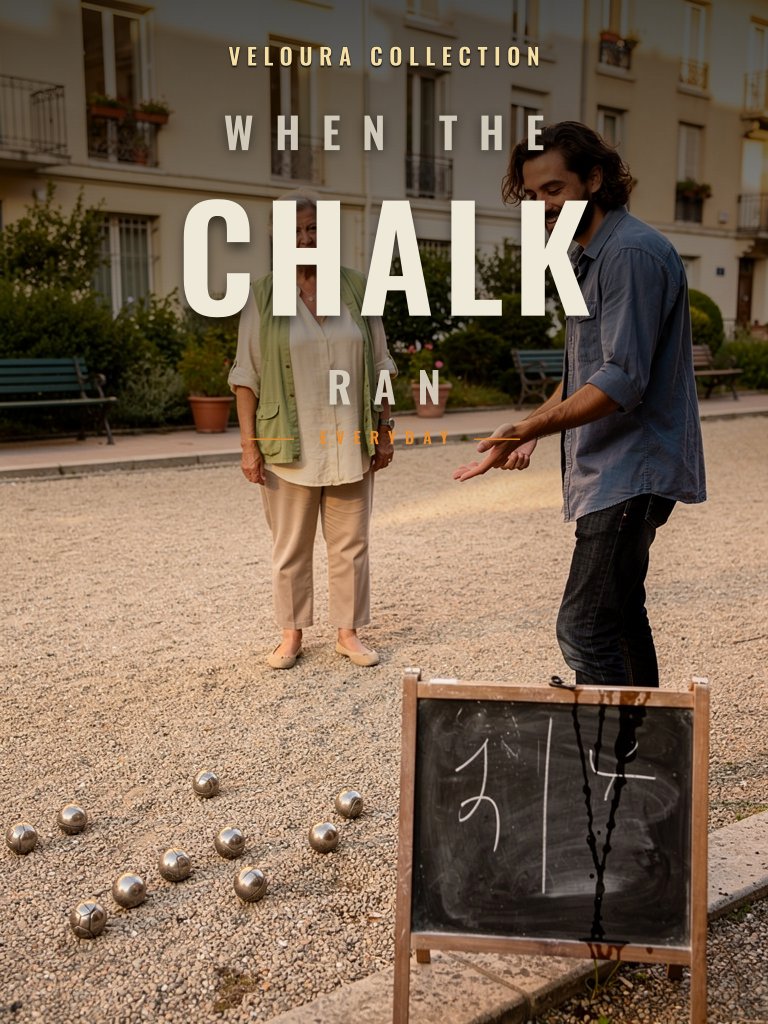
Spilled water erases the score of a pétanque match in Lyon. The players all remember the last round differently.

Chapters · 48 minFully narrated

About the story

On Sundays, neighbours play pétanque on a little gravel court in Lyon. Marceline Vion, who volunteers to keep score, notices the newly arrived Étienne Chabert waiting at the edge. Though Étienne declines an invitation to play, he agrees to take over the chalkboard and begins watching where the boules land. During the game a glass of water spills onto the board, blurring the scores from the last round. The players remember different results, while Étienne apologises even though he did not spill the water. Marceline faces a small but troublesome knot: how should she handle a score no one can be sure of, and make the new neighbour feel at ease among the group?

Theme · Chalk washed away by water leads Marceline to reconsider the place of both the game and the new neighbour on the gravel court.

Chapter 1

At the Edge of the Gravel Court

Listen

Beside the little square in Lyon, footprints marked the edge of the gravel court. Marceline Vion set the chalkboard in front of the bench and put the bag of spare metal boules beside it. The Sunday afternoon was mild, with spring nearing its end. The shade of the trees in the square had not yet reached the court. The board in front of the bench shone in the sun; Marceline turned it slightly so it could be read.

As the players took turns throwing, Marceline filled in the score. She loved watching the boules approach the jack; sometimes the chalk in her hand stopped just when she wanted to throw herself. She had a boule of her own in the bag, but most weeks she did not take it out because someone had to write down the score.

At the other end of the bench sat the new neighbour, Étienne Chabert. For several days he had watched the game as he passed through the square. Today he sat with his hands on his knees, trying to work out who was pleased when the boules came to rest on the gravel. Nadine Perrin noticed him and called from beside the throwing circle.

“Come and play a round. We'll lend you a boule.”

Étienne smiled but did not rise from the bench.

“You carry on. I've never thrown one before.”

“Then it'll be your first throw,” Nadine said.

Étienne scuffed the gravel with the toe of his shoe. It was clear he imagined sending the boule much too far with everyone watching. Marceline set the chalk on the edge of the board. If she tried to draw him towards the circle, he might move away from the bench as well.

“Would you keep score for me? When the boules get close, it's hard to see from here which one is ahead,” she said.

Étienne approached the board. Marceline showed him the two columns and where each round was added. The names were written there; he needed to know nothing else. Étienne took the chalk and carefully rewrote the last number. Nadine gave him a thumbs-up from where she stood.

Marceline stepped back. Étienne was no longer just a spectator. He watched the players and did not hesitate to ask for the result when a throw was over. Marceline closed the bag; perhaps she could choose a boule herself in a little while.

Chapter 2

The Numbers the Water Erased

Listen

Étienne returned to the board after every round. When two boules lay close together, he waited to hear from those making the decision before using the chalk. When one of Nadine's throws fell short, a player on the other side cupped a hand to an ear and said the gravel was calling her. Nadine reminded the player that their previous boule had been looking for the bench. The game went on amid laughter.

Marceline left a glass of water beside the bench. As she bent to adjust the board's stand, the arm of a player rising from the bench brushed the glass. It tipped over, sending water across the lower half of the portable board. Étienne held the chalk in the air. The numbers from the last round grew thick, then ran together. Étienne tried to lift the board, but the water had already seeped beneath the lines. White chalk came off on his fingers; the numbers could no longer be read.

“We had two on our side just now,” Nadine said.

“We wrote down one,” said a player on the other side.

Someone else thought the two had been from an earlier round. Everyone looked at the place where the water had spread; no line remained to prove anyone right. Voices overlapped, but no one looked angry. Nadine held up two fingers to show what she had counted; the player beside her held up one and laughed.

Étienne put the chalk on the bench. He had not knocked over the glass, yet he felt he had failed to protect the board.

“I'm sorry. It got erased while I had it,” he said.

Marceline emptied the last drop from the glass and held the board upright. White water trickled down its wet surface. She saw that Étienne's hands were dry. He had no need to apologise, but she did not want him to feel still more cornered in front of the group.

“The glass didn't even hit you. Let's dry the board first,” she said.

Nadine began discussing the number again with the other player. This time both doubted their own memories. Marceline took out her cloth and wiped the wet lines away. When no trace of the last round remained, the blankness of the board seemed clearer than the argument itself.

Chapter 3

A First Try in the Circle

Listen

Marceline folded the cloth and put it beside the bench. Nadine thought the last score had been two; the player on the other side remembered one. Marceline wanted to trust the number she had written, but could not even remember when she had last looked at the board before the water spilled.

“I don't remember the exact number either. Let's play this round again. It can be a practice; we won't add it to the score,” she said.

No one was losing a prize. Nadine relaxed her shoulders and agreed, and the other player did not object on seeing the blank board. Étienne did not try to fill in the erased space with chalk. Marceline showed him the empty place beside the circle.

“If you like, throw a boule this time.”

“What if I spoil the game?”

Marceline pointed to the wet board.

“There's no written result. No score to spoil.”

Nadine chose a metal boule from the bag and gave it to Étienne. The heavy boule felt strange in his palm at first; he opened his fingers and gripped it again. He threw from the edge of the circle. The boule went far beyond the jack, bounced twice on the gravel and stopped near the end of the court. Étienne grimaced. A few people watched the boule, then returned to their own throws; no one laughed at him. A player went to fetch it and quietly handed it back to him.

Nadine came beside him and lowered her voice, indicating the circle's line with her foot.

“Throw from inside it. And instead of swinging the boule upward, send it as though you were placing it down in front of you,” she said.

Étienne stepped inside the circle. Nadine did not take his arm and correct it; she simply demonstrated a short movement with her own hand. Étienne tried the same movement with his empty hand. He did not hurry his second throw; first he found where the jack lay, then turned the boule between his fingers.

Marceline watched from the bench. She had not filled in the board again yet. A small silence rested over the court; it was not the hard silence of people waiting to see whether someone would succeed. Étienne found a comfortable place on the gravel and prepared for his next throw.

Chapter 4

A Round Open to Everyone

Listen

When Étienne released the boule, this time he did not swing his arm too far. The metal ball travelled a short distance over the gravel and stopped close to the jack. Nadine bent down to look at the distance between them.

“There, it's in play,” she said.

Étienne looked at the boule, then at her. His smile was more relaxed than it had been while watching the throws from the bench. The other players threw their own boules; some came close, others rolled farther away. No one reached for the chalk to record a result. Marceline wrote only the players' names on the dry board, leaving the spaces for scores blank.

When the practice round ended, she opened the bag. She found her own boule, which had sat there for weeks; its familiar weight settled in her palm. Étienne stepped aside to go to the board, but Marceline did not give him the chalk. She leaned the board beside the bench and entered the circle.

“I'm in the next round too,” she said.

Nadine laughed and made room for her. Marceline threw her boule; leaving a little track in the gravel, it came to rest among the others. It was neither the closest nor far away. No one asked how many points it had earned. Étienne picked up his own boule after her. He no longer waited for an invitation for the next throw.

As the daylight drew back to the edge of the square, they put the boules in the bag. Marceline did not erase the names on the board. There were no numbers, but it was easy to see who had played that day. Nadine looked at the board and made a suggestion.

“Next Sunday, let's begin with a practice round like this. Then anyone who wants can move on to a scored game.”

“I can come too,” Étienne said.

“Of course,” Marceline said.

Étienne lifted the board and tucked it under his arm. Marceline took the handle of the bag. As they left the square together, the score of the lost final round was still uncertain. The three had agreed on one thing: everyone had thrown a boule. Étienne offered to carry the board to Marceline's home; along the way Nadine gently teased him about his first throw that had landed near the end of the court, and Étienne laughed and said the boule had chosen its own route.