
Veloura Stories
← Library
The Vanishing Fish
Mystery·Free in full

The Vanishing Fish

At Plymouth’s aquarium, Toby’s fish drawings vanish in the laminator. Mabel looks for the cause before a school visit.

Chapters · 48 minFully narrated

About the story

At Plymouth aquarium, Mabel Ainsley is preparing fish identification cards for a class due the next day. Volunteer Toby Trelawney finishes the drawings; when Mabel puts the first card through the laminator, the fish disappears before her eyes, though the printed heading remains. Toby draws another, and the same thing happens again. Looking at the apparently blank cards, Mabel tries to find out whether the problem lies with the drawings or the machine. There is little time to remake all the cards the children will use. While Toby fears something he did has jeopardised the visit, Mabel begins examining the materials one by one, without blaming him.

Theme · A blank fish card with its printed heading intact reveals the connection between a pen and the hot laminator in the education room.

Chapter 1

The Blank First Card

Listen

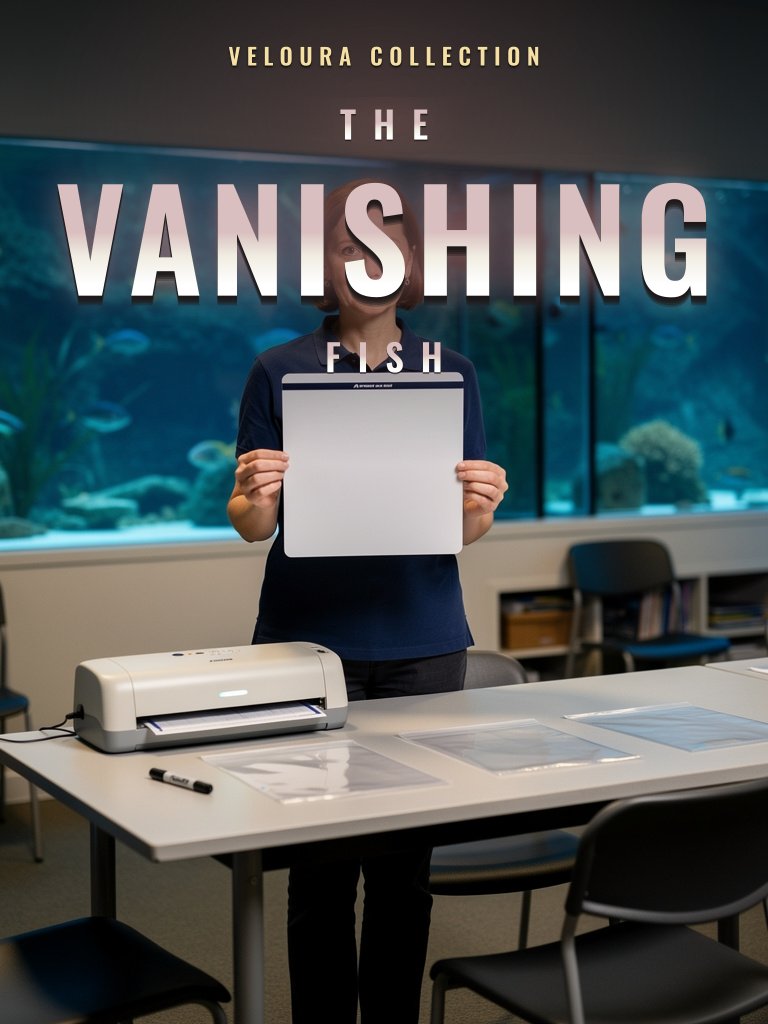
There was a faint smell of seawater in the education room at Plymouth aquarium. Mabel Ainsley spread out the fish identification cards prepared for the class arriving tomorrow. The headings had been printed from a computer; volunteer Toby Trelawney was drawing the fishes' fins and bodies. The children would hold the cards up to the aquarium glass and find the fish they saw. They had printed the headings along the top edge of the cards; Toby was drawing the pictures large enough to compare easily in front of the tank. Mabel rounded the corners of each card and placed it beside the pile on the table. The cards would be laminated so they would not get wet.

Toby added an extra line to a fish's dorsal fin. He rubbed the paper a few times with the back end of his pen. The wrong line faded until it was almost invisible. Mabel bent over the paper.

“That's a neat correction,” she said.

“It's easy with this pen. When I get a fin wrong, I don't have to throw away the whole sheet,” Toby said.

Mabel placed the first card in the mouth of the hot laminator. The machine slowly drew it in; as the clear surface emerged at the other side, Mabel caught the corner of the card. The printed heading was still dark and sharp. The tail of the fish below it, however, faded, and then its body disappeared. By the time the card reached her hand, the drawing was gone.

“It was there when it went in,” Toby said.

Mabel turned the card towards the light. There were no ripples or scratches on the clear surface. The heading was legible; beneath it was only white paper. Mabel looked at the other drawings on the same table. Every one was in place. The blank space in her hand looked so neat that it might have been made that way from the start.

“What did the machine do to it?” Toby asked.

Mabel did not answer. She put the card at the edge of the table, beside the ones with visible drawings. The difference was clear at a glance. Blue light from the large tanks outside fell into the room through the gap in the door; the fish out there were still in place.

Toby took a new sheet of paper.

“I can draw the same one again,” he said.

Mabel looked at the machine's plug and the pen in Toby's hand. First they needed to see what would happen to a second card.

Chapter 2

The Blankness That Came Out

Listen

Toby drew the same fish on a second sheet of paper. This time he corrected nothing; he showed Mabel every line as he lifted his pen. Eye, tail, dorsal fin. Once it was placed beneath the printed heading, they could both see the card was complete. Mabel slipped it into a clear laminating pouch and waited at the mouth of the machine.

As the card passed through, the lines faded again. Toby had not touched the drawing this time. The last curve of the tail vanished before their eyes. Mabel switched off the machine. She put the second blank card beside the first; both headings were legible.

“The rollers might be scraping the paper,” Toby said.

Mabel felt the clear surface with her finger. There was no black mark on it. She looked at the machine's exit; there was no loose ink or scrap of paper there either. She picked up Toby's pen.

“Did you write the headings with this?”

“No, those came from the printer. I drew the fish.”

Mabel returned to the first drawing on the table. The paper was not worn where Toby had rubbed out the wrong fin; the line had simply faded. The paper on the cards that had come out of the machine looked intact too. The pen lines were common to both events.

“So is my drawing the problem?” Toby asked.

“Let's look at the materials first,” Mabel said.

They laid out the remaining cards and checked them in turn. The drawings were visible before going into the laminator and disappeared after coming out. The last tray filled with blank-looking cards too. Toby put his pen on the table. They now had a stack of cards for tomorrow's class with headings, but no fish to show.

Mabel did not put a single card through the machine again. To understand what had changed after the misstep, she could first experiment on blank paper. She held out a small piece to Toby.

“Will you draw me two short lines side by side with the same pen?”

Toby drew them. Mabel placed the paper beside the printed heading; this time she would watch the difference between the two carefully.

Chapter 3

The Line That Returned in the Cold

Listen

The two short lines Toby had drawn side by side lay on the table. Through the open door came the hum of the tanks. Mabel divided the paper in two. She rubbed the line on one piece with the back of the pen; the colour faded, but no crumbs fell onto the table. She held the other piece near the laminator's exit, without touching its hot body. After a few seconds, that line faded too.

“They look the same,” Toby said.

Mabel turned the pen over. Its barrel said erasable ink; the small instructions also said it faded with heat. Toby had thought the correction was scraped off the paper. Now the two pieces before them bore the same mark, vanished without damage to the paper.

“It could be heat,” Mabel said. “But we don't know whether these lines will come back.”

The aquarium's freezer for animal feed was in a nearby storeroom. Mabel put the test paper in a clear bag and took it there with Toby. They opened the freezer and put the paper inside. While Toby watched the time, Mabel noted the order of the cards she had left in the room; she did not want to confuse which one had been the first trial.

When the paper was cold enough, they took out the bag. Without opening it, Mabel held it to the light. The faded lines had become distinct again. Toby touched the bag and smiled.

“Will the fish come back too?”

Mabel took out the test paper, put the first laminated card in the same bag and placed it in the freezer. They had to wait; Toby suggested looking every minute from in front of the lid, and Mabel said that would not cool the paper any faster.

After a while they took the card out. The heading was unchanged. Beneath it the fish's body and fin were visible, even the faint trace of the line Toby had corrected. Mabel photographed the card before setting it on the table; she now knew it could fade again if it warmed up.

“The machine didn't take the drawing,” she said. “Heat made it invisible. Cold brought it back.”

Toby held the card between both hands. Keeping the fish cold could not be the solution for tomorrow. But they could copy them while they were visible.

Chapter 4

The Fish the Children Saw

Listen

Mabel and Toby chilled the remaining cards one by one. As soon as the drawings became clear, they made copies. On the new cards from the printer, the fish appeared in permanent printing ink; Mabel left one beside the machine and checked that the lines did not fade. Then they placed them all in clear card sleeves. There was no need for heat lamination. Toby put the originals in a separate folder and laid his erasable pen on top.

The next morning the class came to the education room. The children spread out in front of the tanks with the sleeved cards. One compared the tail on a card with the tail of a fish swimming behind the glass; another called a friend over to count fins. Mabel divided the class into small groups and gave each group different cards. When the children found a fish, they held the card out to their friends and pointed to the living creature behind the glass. Toby moved among the groups, helping the sleeves return to the correct stacks. Seeing that Toby's drawings were useful, Mabel looked at him and smiled. As Toby gathered the papers, he checked twice that none of the drawings had been left beside the glass.

At the end of the lesson, Mabel took out one of the old cards.

“Yesterday this fish seemed to have disappeared,” she said. “Let me show you how.”

She brought the card close to the machine she had heated beforehand. The line slowly faded; the printed heading did not change. The children took turns holding the card up to the light. Mabel showed them a photograph she had taken of the same card when it was cold and explained that the drawing became clear again in the cold. The pen's ink changed colour with temperature; the fish had not left the paper and gone somewhere else.

“Then why doesn't the fish in the sleeve go away?” a child asked.

“Because that one was made with printing ink. It stays visible at the same temperature,” Mabel said.

Toby laid out a blank sheet on the table for a new card. This time he chose a different drawing pen. If he drew a fin incorrectly, he would have to start again on a new sheet; now he did not mind. Mabel helped the children put the cards back into their sleeves. In the blue light from the tanks, the drawings were all in place.