
Veloura Stories
← Library
No Delays
Comedy·Free in full

No Delays

At a Yokohama exhibition Minori promises a punctual model railway. Then the train refuses to leave the platform.

Chapters · 48 minFully narrated

About the story

At a neighbourhood hobby exhibition in Yokohama, Minori Sakai is determined to run her club's five-station model railway exactly on schedule. She promises exhibition organiser Ayame Kuroda as much. Her fellow club member Genta Hoshino places a little advertising sign reading No Delays and a bus beside the third station; Minori removes the bus, finding it irrelevant to the railway line. The children are seated in the front row, waiting for the first run. When the show begins and the train stops at that same platform, Minori's solemn station announcements echo through the audience. With the next club's time on stage approaching, one tiny stop gives everyone a sufficiently large job.

Theme · A sign promising a delay-free journey falls onto the tracks of a five-station model railway and gives a little bus a real job.

Chapter 1

A Five-Station Promise

Listen

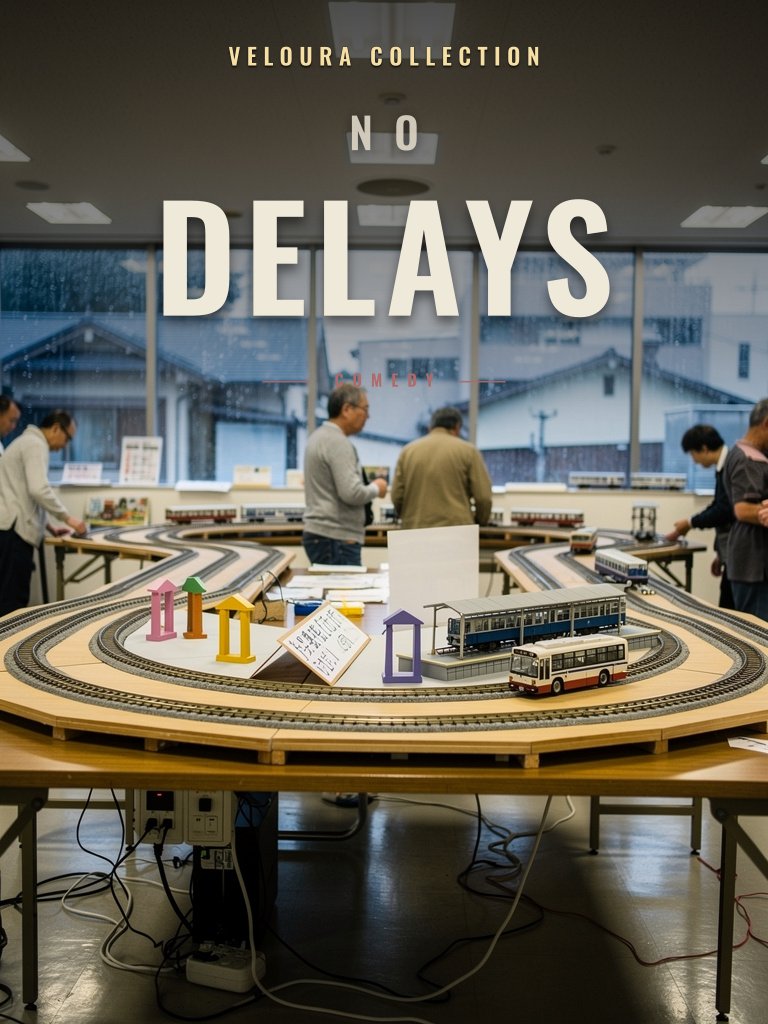
Rain beat against the windows of the neighbourhood hall in Yokohama. Inside, folding tables stood side by side, with the five stations of a model railway set up on top. Minori Sakai turned the controller's knob. The train left the first platform, crossed the little bridge and stopped at the last station. One complete circuit, in exactly the time she had planned. Cables ran beneath the tables, and hand-painted little houses stood behind the tracks. After the circuit, Minori checked each connection with her finger; she did not want the train stopping somewhere unexpected.

Exhibition organiser Ayame Kuroda looked at the programme in her hand. She reminded Minori that the next club would also be using the small stage.

“We'll finish on time. Five stations, one circuit, then questions. I've calculated it to the minute,” Minori said.

Ayame smiled.

“Have you allowed a minute for the children's questions too?”

Minori turned over her calculation sheet. The back was blank.

Genta Hoshino from the club put a small advertising sign beside the third station. It read No Delays. The base beneath its thin post wobbled slightly; when Genta pressed it down, it stood upright. He placed a tiny bus he had made beside it. He also arranged toy passengers waiting at the stop around a bench.

“Why is there a bus here?” Minori asked.

“Stations have buses.”

“There's no bus stop on this route.”

She took the bus and put it on the storage shelf beneath the table. Genta watched it go while straightening the sign.

“It'll be needed one day,” he said.

“Not while the trains are running.”

Children began to sit on the chairs in the front row. One counted the stations with a finger, while the child beside them tried to choose which carriage to sit in. Minori picked up the controller. Ayame welcomed the crowd at the door inside. As Genta passed the sign one last time, his elbow touched the table; the sign stayed where it was.

This time Minori looked at the blank paper and added a line for the children's questions. Then she switched on the light at the front of the train. Conversation in the hall quietened. The first run could begin.

Chapter 2

A Long Stop at Platform Three

Listen

The train passed the first two stations without a problem. Minori showed the children the tiny platforms and announced the station names in a solemn official's voice she had invented. As it approached the third station, the locomotive gave one shudder and stopped. The little light at the back of the carriages stayed on.

Minori switched the controller off and on again. The train moved a finger's width, then stopped in the same place. The children in the front row leaned forward in their chairs. Genta went around the model bridge to the back of the table.

“The motor might be overheating,” he said.

“It hasn't even completed a circuit,” Minori said.

A child raised a hand.

“What will the passengers do?”

Minori leaned towards the microphone. She made her voice especially grave.

“Dear passengers, you may enjoy the view from platform three a little longer than scheduled.”

Several voices in the front row repeated the sentence loudly. The adults at the back laughed. Minori's ears grew warm, but she raised her head as if the announcement were finished.

Genta looked at the controller connection. Minori signalled for him not to touch the train; first she switched off the power. The children took that for an announcement too and told one another that the power had been cut. Ayame came to the side of the stage and checked her watch.

“The next club is getting ready,” she said. “You have a little time to find the problem, but we can't extend the whole programme.”

Minori returned to the microphone.

“The inspection continues. Passengers do not yet need to change platforms.”

This time the children joined her from the first word. When Minori stopped speaking, they finished the sentence themselves. Genta bent down and looked under the station roof, but in the shadows he could see only the carriage wheels. The train waited on the track, the passengers on the bench.

Ayame brought a chair and set it facing the children.

“At real stations someone tells you what's happening too,” she said. “Here it's easy to give updates, and the train is small.”

One child cupped a hand to an ear as if waiting for the next announcement. Minori looked at the microphone; she still had an unresolved stop in front of her.

Chapter 3

The Bus's First Official Service

Listen

One of the children in the front row stood up.

“The writing over there has fallen down,” the child said, pointing to the third station.

Minori could not see the sign Genta had put there. The station roof covered the little platform. After making sure the power was off, she lifted the removable roof with both hands. Inside, the No Delays sign had fallen across the track. The train's front wheel was pressed against its base.

Genta bent down and picked up the sign. The glue underneath had not held. He turned the sign in his hand and examined its base. The children who read the words on it giggled. One of the children in the front row made an announcement of their own:

“There's a delay because of the No Delays sign!”

“The motor's fine,” Minori said.

“So is the sign. It just doesn't like staying in its place,” Genta said.

With the roof in Minori's hands, the inside of the station looked like an empty box from the middle of the hall. The children saw behind the scenery for the first time. Someone asked whether the model passengers would get wet on a platform without a roof. Minori listened to the real rain in the hall.

“Rain doesn't get inside on this line,” she said. “However, we are arranging replacement transport for the train.”

She set the roof on an empty corner of the table, then took the little bus from the shelf below. She placed it on the road beside the stopped train.

“A bus will depart from the third station for the fourth. Please keep your tickets; nobody will check them on the bus, but keep them for the sake of order.”

The children all repeated the end of the announcement together again. Minori allowed them to come closer one by one. They arranged the toy passengers waiting on the bench in a little queue; nobody tried to fit them inside the bus. Behind the table, Genta secured the base of the sign again.

Ayame watched the stage from the door. Minori moved the bus forward a hand's length and stopped it. The tiny passengers stayed where they were; the crowd was willing to imagine them boarding. Genta showed that he had cleared the track. Before reaching for the controller, Minori asked the children to add the last passenger to the queue. This delay needed an end time too.

Chapter 4

The Bus Added to the Timetable

Listen

Minori sent the children back to their chairs and fitted the roof back onto the third station. Genta checked once more that the track was clear. When Minori switched on the controller, the train moved gently at its first attempt. It reached the fourth station, passed the fifth and returned to the starting platform. The applause in the hall lasted longer than the modest light at the start of this little circuit.

“Our passengers have completed the full circuit, even if delayed. The bus we put in its place has done its job too,” Minori said into the microphone.

A child raised a hand.

“Will the bus come back?”

Minori looked at the bus at the edge of the table. Genta had reached out to take it. Minori was quicker.

“There is a return service. This time we're choosing the driver from the audience.”

Two children took turns moving the bus a handspan at a time along the model road. The others made the stop announcements. Minori set a rule: the bus must not go onto the tracks, and the passengers must not fall off the bench. The children paid more attention to the rules than to the train's minutes.

Ayame stepped onto the stage and thanked the club. Members of the next club were waiting at the door with their belongings; the crowd in front of the table dispersed before the allotted time was up. Minori switched off the controller. As Ayame started the next show on the programme, she nodded to her.

Genta glued the repaired sign behind the third station, somewhere away from the track. He stepped back and read the words.

“It caused the delay itself,” he said.

“From now on, where the sign stands will be on the timetable too,” Minori said.

She added a note to the back of her calculation sheet: bus connection at the third station. When Genta held the bus out towards the storage shelf, Minori shook her head. She turned over the precise timetable on the front of the paper and added a small mark beside the bus note on the back to remind her of the children's own announcements. This time they put it on the little road at the edge of the layout. Rain was still beating against the windows; the model passengers had an alternative while they waited.