
Veloura Stories
← Library
New Life on Parnassus
Mythology·Free in full

New Life on Parnassus

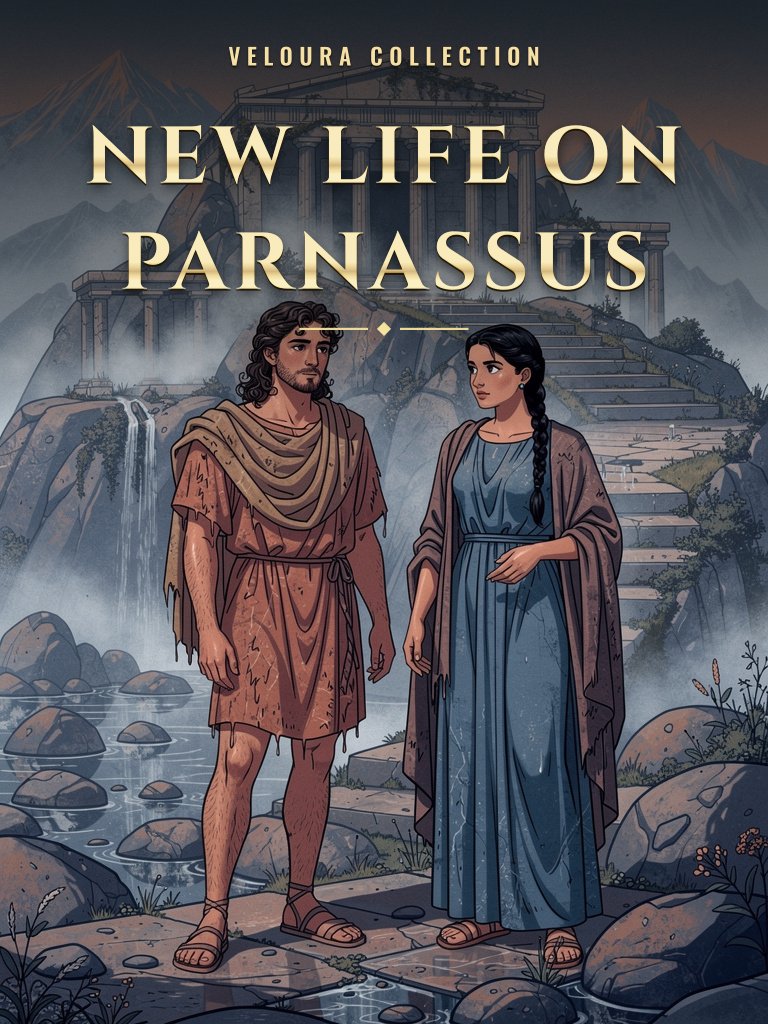
After the great flood of Greek myth, Deucalion and Pyrrha face a riddle from the goddess Themis on Mount Parnassus.

Chapters · 48 minFully narrated

About the story

After the great flood, Deucalion and Pyrrha's boat comes to rest high on Parnassus. As the waters recede, they see mud stretching below them where cities and fields once stood. Having survived makes the question of what they can do for the human race weigh all the more heavily on them. They decide to go to the shrine of Themis and ask for people to return. But the goddess's command, when first heard, seems to demand that they disturb their mothers' bones. Pyrrha objects, and Deucalion too believes their wish cannot be granted through such disrespect. When they leave the shrine, they face words they must both understand and put into practice.

Theme · The stones of Parnassus lie before a couple asking how the human race can be born anew after the flood.

Chapter 1

The Slope Where the Waters Receded

Listen

The waters had risen to the mountains' necks. The borders of fields, the roads of cities and the roofs of houses had vanished beneath them. For days Deucalion and Pyrrha's little boat drifted like a leaf carried by the current. At last its bottom struck something hard; the boat came to rest on an exposed upper slope of Parnassus.

At first Deucalion did not let go of the oar. Water still flowed past both sides of the boat. Pyrrha leaned over the bow and tested whether the rock was firm. Together they stepped ashore. Their wet cloaks were heavy, and their sandals sank into the mud. When they looked back, the boat had stayed in place. Ahead of them the slope rose among stones emerging from the water.

They remained there for a while. In the distance, where a shore had once stretched, only a broad expanse of water was visible. Deucalion shaded his eyes with his hand and searched for the cities below. He could make out neither a roof nor a wisp of smoke. Pyrrha came to stand beside him; where they looked, nothing recalled the sound of a human voice.

“Let us thank the gods that we are alive,” Pyrrha said.

Deucalion bowed his head. As he gave thanks, he asked for neither food nor shelter. He thought of those beneath the water and wondered what good it would do for the two of them to have survived. When he turned back to the boat, he saw room enough for two; for the earth, that was far too little.

The waters slowly began to recede. Wet earth appeared on the slope, followed by the mud of the plain below. The farther they could see, the greater the emptiness grew. They searched for a way across places once covered by water; no trace on the ground led them to other people. The flood had erased the sounds of daily life as well. Pyrrha wrung the mud from the hem of her cloak.

“How will people come back?” she asked.

Deucalion looked at the path revealed on the slope. The shrine of Themis was there. Without consulting the oracle, they had no answer to the question. They tied the boat to a solid rock and walked together to the shrine, their feet sinking into the mud as they followed the marks left by the water.

Chapter 2

Themis's Heavy Command

Listen

The drying mud on the shrine steps had cracked. Deucalion and Pyrrha poured water they had carried in the boat over their hands and washed their faces. Mud ran from the hems of their wet clothes. When they entered, a thin deposit left by the flood covered the stone floor. The door stood open; light filtering in from outside fell across the middle of the empty hall.

Both knelt. Deucalion did not list the lost cities; he spoke of what they all lacked.

“Themis, how can the human race return? Show us the way,” he said.

Pyrrha bowed her head too. The silence in the shrine stretched on. Then the goddess's voice was heard, unmixed with any other sound. The command was brief: they were to cover their heads, loosen their garments and throw the bones of their great mother behind them. When the voice fell silent, only the intermittent tapping of drops of water remained in the stone hall. Pyrrha raised her head and looked at the door. Outside were the marks of the receding water; where the command would lead was not written on the stone floor.

Pyrrha did not rise. First she repeated the command in her mind; the words did not change. Even the thought of disturbing her mother's remains weighed on her. She turned to Deucalion and spoke softly.

“I cannot unearth my mother's bones. I will not do such a thing.”

Deucalion took her hand. In their prayer they had wished for human life to begin again. To ask for it by dishonouring a mother seemed contrary to the prayer itself.

“Nor would I ask you to,” he said.

Pyrrha looked at the shrine door. The road down the mountain was visible, but the path shown by the words was still closed. The two rose and went outside. Standing on the wet stones, they did not cover their heads or loosen their garments; first they needed to understand what they were to throw behind them.

From the shrine threshold, Deucalion looked down at the earth emerging below. Pyrrha's refusal was not merely fear. He too believed that if the oracle's words were followed to the letter, they would undo their own plea. So they took their time and thought together. Who could the great mother be? That question required them to listen again to the other parts of the command they had heard.

Chapter 3

The Hard Bones of the Earth

Listen

The mud at the shrine threshold formed a crust as the sun began to appear. Deucalion turned over the stone beside his foot. The water had shifted it, but had not broken it. He took the stone in his palm; Pyrrha was still facing the door.

“The great mother may not mean only our own mothers,” Deucalion said. “The earth that bears us all can be called a mother too.”

Pyrrha turned to him. Deucalion showed her the stone in his open palm. The earth was soft, but the stone was the hard part within it. It endured like a bone in a body. If these were the bones in the goddess's words, they did not need to open anyone's grave.

“Then why do we throw them behind us?” Pyrrha asked.

“To obey her words. But knowing that what we throw belongs to the earth,” Deucalion said.

Pyrrha crouched and picked up a stone. Its surface was rough, with mud packed into its crevices. As she weighed it in her palm, she thought of the other two commands they had heard in the shrine. They would cover their heads, loosen their garments and throw the stones behind them as they walked. All the words seemed possible to obey. She did not claim to be certain; even so, this interpretation did her mother no harm. Deucalion did not put down the stone in his palm either. For a while, together, they weighed the weight of the stone and the weight of the word.

Both drew their cloaks over their heads and loosened the tight ties of their garments. They gathered as many stones from before the shrine as they could hold in their hands. As they began to walk down the slope, Deucalion threw the first stone over his shoulder. Pyrrha cast hers behind her too. They heard a dry impact behind them. They did not turn around.

Every few steps they bent to pick up more stones. The ground was wet; when their sandals slipped, they waited for each other. Through the folds of the cloak over her head, Pyrrha could see the path ahead. As Deucalion threw the stones, he followed the bend of the path so as not to lose his direction.

“Did you hear that?” Pyrrha whispered.

Behind them, after the sound of stones, another, softer sound had risen. Deucalion kept walking. He wanted to turn and see what it was, but believed they must finish obeying the command first.

Chapter 4

The People Within the Stones

Listen

They walked farther down the slope. The soft sounds behind them multiplied; they did not resemble stone striking stone. Deucalion cast the last stone behind him. Pyrrha threw the little stone in her hand and stopped. They pulled their cloaks away from their faces and turned together.

The stones on the wet ground were no longer as they had thrown them. Their hard edges were dissolving, their surfaces softening. First vague outlines appeared, then arms and shoulders. Men formed from the stones Deucalion had thrown, and women from those thrown by Pyrrha. Their bodies slowly stood upright; only the endurance of the stone seemed to remain from its former shape.

Deucalion looked from one to another. None was the exact likeness of anyone the waters had taken. Pyrrha walked toward a woman standing on the wet earth. For a moment she did not know what to say. The newcomers too were looking around, seeing the stones on the slope and the plain opening below.

“Welcome,” Pyrrha said.

The woman looked at her. Deucalion came to Pyrrha's side. Their cloaks were still damp; mud lay beneath their feet. The ground could scarcely bear even their steps yet. What they had wished for had happened, but no established city, ploughed field or ready house stood before them. They would have to build the place where they would live together themselves.

“We can go down,” Deucalion said.

A man lifted his foot and set it on firm ground on the path. Then the others began to walk too. Deucalion did not go at the front; when he saw a loose stone on the slope, he stopped and pointed it out to those behind him. Pyrrha walked beside the new woman. The sun had emerged from the clouds, leaving bright traces on the land from which the water had receded.

The shrine remained high above. The emptiness below was beginning to fill with the voices of people walking. Deucalion and Pyrrha looked back once more: their boat was out of sight, but the stones of Parnassus were everywhere. Both turned in the same direction as the newcomers. First they would descend, then learn to use the land; human life had begun again here, among the stones.